#header-inner { margin: auto; }
Showing posts with label Doctrine. Show all posts

Thursday, March 10, 2011

I am fully aware of what God hates. He tells me in His Word:

16 There are six things the LORD hates,
seven that are detestable to him:
17 haughty eyes,
a lying tongue,
hands that shed innocent blood,
18 a heart that devises wicked schemes,
feet that are quick to rush into evil.

Yet I persist in my haughty eyes. I persist in the other sins too, but my haughtiness is what God has been convicting me of lately.

Why is it that I so often think I Would Never? I think How Could They? I think I'm So Glad I. And I can only imagine what my God is thinking as I have those thoughts.

Yuck. To realize that I have had yet another conversation where I have been talking about or listening to how others fall short makes me frustrated with my deceitful and desperately wicked heart.

That fall is going to hurt.


But that is the sin, and here is the hope: Christ shed His blood for that sin, and all of my other sins. God is so good to convict me through the Spirit, and He is faithful and merciful to distance me from that sin, as far as the East is from the West. As I learned at a recent retreat, sin is not just saying, "I'm sorry"... it is saying, "I'm through.". That is much easier said than done, but I surely cannot do it on my own power. Let's hear it for grace!

It was this passage that God used to convict me this morning:

25And whenever you stand praying, forgive, if you have anything against anyone, so that your Father also who is in heaven may forgive you your trespasses."

If I am harboring even a little bit of bitterness, I have to confess it before the Lord can forgive me of that bitterness. OK, I think I got it.

It's Thursday. I like Thursdays.

Thursday, February 24, 2011

A Happy Heart

Do you remember things your own mother would say over and over again? Mine would say, "Because I am your mother, and I said so".

Beau's mother would say, "Cry softly!".

I say, "Have a happy heart".

All of these things, I am sure, grate on a child. Who wants to hear the same thing over and over again? All of these little sayings are rather hard to understand on one's own, especially if one is under the age of 4. Self-control is a virtue that I have to cultivate in my own so-called adult life every day. I can't expect my child to continually and satisfactorally "have a happy heart" just because I tell him or her to. What the heck does that even mean?

After another discipline session with my dear moody 4-almost-5-year-old son yesterday afternoon, I explained to him- again- that he needs to obey immediately, and with a happy heart.

Blank, teary stare.

OK, Mama. You can get through to this kid. Lord, I prayed, teach me so I can teach him. What do I say? I just kind of stared back at him for a minute.

He broke the staring contest. "Mom, I can't always have a happy heart. I just can't! Sometimes I am sad."

I glanced above his headboard, where I had posted three Scripture verses, sitting small and forlorn in the vast expanse of green wall above his bed.

16 Rejoice always, 17pray without ceasing, 18give thanks in all circumstances; for this is the will of God in Christ Jesus for you. 19 (1 Thess 5:16-18).

Ah. The Word of God never comes back void. How can we have a happy heart? By praying continually. By giving thanks in all circumstances. The children are familiar with giving thanks. Every day, we all tell God something we are thankful for, sometimes numerous times a day. This is mainly for the purpose of getting Mommy's heart in check while she feels overwhelmed or angry. The kids play along, usually enjoying this activity. Answers range from, "I'm thankful for this chocolate milk!" to "I'm thankful for Daddy!".

God was faithful to immediately answer my heart's prayer, giving me Scripture to teach with. And interestingly enough, as I tried to share this truth with an unsaved 4-year-old, God was working on my own stony heart too. I don't walk around joyful all the time. In fact, I was having a pretty crappy day yesterday. I yelled at all the kids before we even left the house at 8:30...for Bible Study. (Please, children, don't tell your teachers how Mommy yelled at you this morning already!) I didn't want to be back in my son's room for another discipline session. I just wanted to leave him in there for the rest of the day and go out back with some coffee to read a book. But the Lord was faithful to start working on my heart, showing me how to obey His command to be joyful continually.

So one of my little mental goals today is to not just tell the children to have happy hearts, but to show them through example- by praying aloud with them intermittently during the day and by giving thanks. Not because works please God, not to be some sort of pseudo-pious religious lady, but because my heart was changed ever-so-slightly yesterday and I want to reflect that back to my Father in gratitude.

Monday, September 21, 2009

Do Babies go to Heaven? Or, Safe in the Arms of God.

Skip this post if you are feeling as though your Monday is heavy enough already...

I have been struggling in spirit for a few weeks after discussing spiritual issues with my dear friend. She is a godly mentor and mighty woman of God. I enjoy every moment we get to have together. I love to learn from her. But I told her that there is one issue that I differ with her on.

What happens to babies who die? Do they go to heaven?

As a 5-point Calvinist, I hold fast to the doctrine of election. Scripture is clear that we are chosen in Christ before the foundations of the world. That has always given me peace. But after our discussions, I began to think of what would happen to an infant who dies who is not elect.

Would God send a baby to hell?

God could. God is perfect and holy and just. Every person is conceived in sin, born into sin, and bears the scar of original sin. We have offended our holy God and He is righteous to judge us.

But a baby? My baby?

I had to search the Scriptures immediately to gain insight on what truth is regarding this matter. The issue is personal to me. I know that there were lives inside me that were, at a point, ended. Did those tiny, innocent beings go to hell or heaven? While I know that they bore the stain of sin, they were never able to choose to sin or deny their Christ. However, I didn't want to have my doctrine shaped by my feelings or emotions of anxiety and sadness. I didn't want to believe my babies were in heaven simply because that is what I wanted to believe. I desired truth.

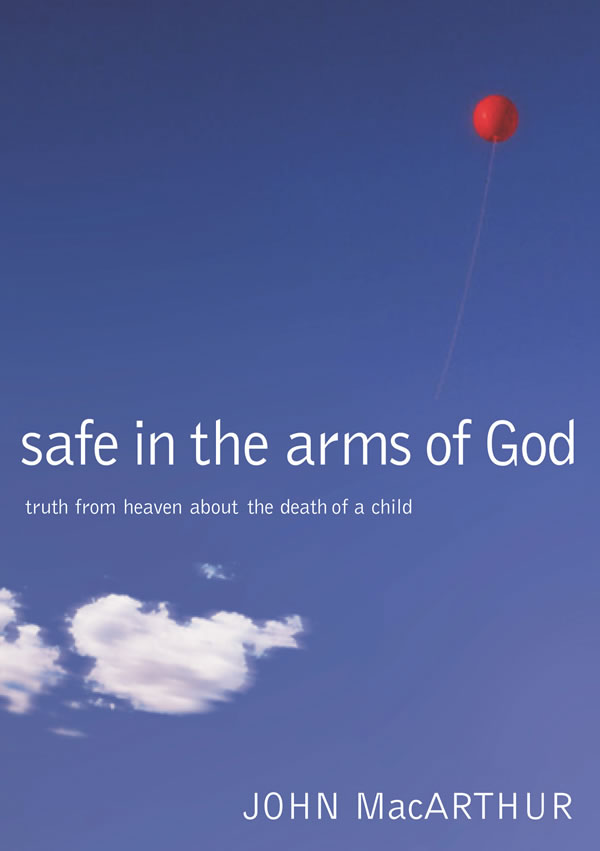
I began reading Safe in the Arms of God, by John MacArthur. It is the only book I have in my library that discusses such matters. I felt as though my soul were in despair as I began to pore through the chapters. Here is a synopsis of what I found:

"There is none righteous, no, not one; there is none who understands; there is none who seeks after God.." (Rom 3:10)


We are all sinful. Our hearts are deceitful and desperately wicked. We are sinners from birth- it is our nature.

However, salvation is a free gift. It is a loving act of mercy by a patient God who loves His creation. I can do nothing to earn my salvation. An infant, by comparison, can surely do nothing to earn his salvation. How great is the picture of grace and mercy when viewed this way!

Charles Spurgeon, in response to the accusation that Calvinism essentially damns infants to hell, said this:

"...We say with regard to infants, Scripture saith but very little, and therefore where Scripture is confessedly scant, it is for no man to determine dogmatically...We [Calvinists] hold that all infants who die are elect of God and are therefore saved...I believe that the Lord Jesus, who said 'of such is the kingdom of heaven' doth daily and constantly receive into His loving arms those tender ones who are only show and then snatched away to heaven."


But how does God accept sinful beings into His presence? The few Scripture passages discussed on this issue basically say that God looks at tiny children as innocents. Again, this is not to say that babies are not sinful. They are. They are sinners from birth. But there is a difference between an older person who chooses to sin or chooses to reject Christ, and a mind that is not capable of making that decision. As beings who cannot walk or talk, babies are truly incapable of choosing wrong. They are naturally bent toward it, but they do not choose it. Does that make sense? Here is what God says about babies:

"...Moreover your little ones and your children, who you say will be victims, who today have no knowledge of good and evil, they shall go in there; to them I will give it, and they will possess it [the Promised Land to the Israelites]." Deut 1:39


Without being able to choose sin or reject Christ, Scripture seems to say that God regards tiny children as "innocents".

In contrast, our works, our evil, is the basis for unrepentant sinners to spend eternity in hell. We are saved by grace but cursed by works. When Scripture talks about sinners in hell, it refers to the deeds that sent said sinners there.

"Do you not know that the wicked will not inherit the kingdom of God? Do not be deceived: Neither the sexually immoral nor idolaters nor adulterers nor male prostitutes nor homosexual offenders nor thieves nor the greedy nor drunkards nor slanderers nor swindlers will inherit the kingdom of God." -1 Cor 6:9-10

"Of this you can be sure: No immoral, impure or greedy person—such a man is an idolater—has any inheritance in the kingdom of Christ and of God." - Eph 5:5

"And I saw the dead, great and small, standing before the throne, and books were opened. Another book was opened, which is the book of life. The dead were judged according to what they had done as recorded in the books. The sea gave up the dead that were in it, and death and Hades gave up the dead that were in them, and each person was judged according to what he had done. Then death and Hades were thrown into the lake of fire. The lake of fire is the second death. If anyone's name was not found written in the book of life, he was thrown into the lake of fire." Rev. 20:12-15

You see the point. We, at some point, choose to sin because that is what we do. Babies cannot choose to sin. This supports the thought that babies are innocent. A holy God can bring babies to heaven because He is merciful, just, and loving. "Innocents", says MacArthur, "are graciously and sovereignly saved by God as part of the atoning work of Christ Jesus." (81)

If the Lord decides to use me to comfort a grieving mother at some point in the future, I will not have to offer empty platitudes, wishful thinkings, or half-truths. I can see the solid Scriptural case that babies who die are welcomed into eternity with the Father.


Wednesday, July 8, 2009

Roots

"Each heart knows its own bitterness, and no one else can share its joy". -Prov. 14:10

For the last week, I have been struggling intensely with bitterness. Bitterness is a complicated emotion- for me, its components consist of anger, guilt, hurt, shame, frustration, and frighteningly, twinges of hate. I have been crying out to God that He would release me of my sin. I know it is wrong. I can feel my heart hardening each time I replay the scenario in my mind. My culpability diminishes and I can only see how the other person was wrong. However, Scripture is clear that each person thinks of herself as wise in her own eyes. Rarely does a conflict occur in which one person is solely to blame. I was as much the instigator and perpetuator as was the other party, and for this, I am ashamed. Showing Christ's love is easy when your life is filled with kind, godly people. At least I can freely show love and grace to people I get along with. I realized this week that to love as Christ loves means I must put aside my initial emotional response of pride. If untrue or unkind things are said about me or to me, I can practice my faith, show love, and count myself thankful to share in this one minor suffering as Christ did. This sounds so noble as I write it and it serves to make me even more ashamed of my behavior and thoughts since this particular incident. My heart knows where it harbors bitterness. My part of the process of sanctification is to identify this, root it out, and freely give all of it to God.

"Get rid of all bitterness, rage, and anger, brawling and slander, along with every form of malice. Be kind and compassionate to one another, forgiving each other, just as in Christ God forgave you. " -Eph. 4: 31-32

I cannot give it of my own accord. My heart has a tendency to want to stay black and unregenerate. Scripture tells me to rid myself of bitterness, however, so I must meditate on the Word and pray that God would take it from me. It is certainly more fun for me to sit and stew and convince myself how I am so right and the other party is so wrong and how dare they and so on. But I desire to be a godly Christian, a godly woman. I desire to have a soft and tender heart all of the time, not just in front of my Christian friends or for show. I want to grow into a mighty woman of the Lord and seek wisdom all the days of my life. But to where do I look for wisdom?

"But if you harbor bitter envy and selfish ambition in your hearts, do not boast about it or deny the truth. Such "wisdom" does not come down from heaven but it earthly, unspiritual, demonic. For where you have envy and selfish amnition, there you find disorder and every evil practice." -James 3: 14-16

God's wisdom is all that I should seek. His truths are simple- love as I have been loved, forgive as I have been forgiven. While I do not have the power to do that on my own, He freely gives me the strength do to it through Him. So I will press on. To show good fruit, my roots must be unwavering.

Thursday, March 26, 2009

Poverty of Spirit

It is 8:11 and my children are still sleeping...let's blog!

"God shows us our poverty of Spirit when we try, in our own strength, to walk in a way pleasing to God...and yet continually fail" (Praying God's Word by Beth Moore, 63).


I have had a large lesson in humility over the past week. It started with some small complications in this pregnancy. My pride in being "healthy" was stripped away. I assumed that by eating clean, organic, whole food and exercising, that I would have as many healthy, problem-free pregnancies as I desired. God's ways are not my ways. Our baby seems to be perfectly normal, but for a few days, we were not sure, and I had an opportunity to fully lean on and trust my Father.

Then, my husband returned home after a nourishing Bible conference in Florida. We missed each other while he was gone, especially due to the fact that we had the minor pregnancy emergency while he was across the country. But he came back, I was fine, and I began to be irritable and contentious once again. And we know what Scripture says about a contentious woman.

My husband is blessed with a unique ability to commandingly yet lovingly address my sin, but my pride usually blocks me from seeing his loving intentions. So I ignore him, continue in my inward bitterness, and hope it will all go away. But that is not God's way, either.

In our small group study this week and again in my personal Bible study, God taught me that humility is vital to sanctification. I know this, I just conveniently forget it when my desires are not met. Paul Tripp, who writes the study, says that desires are not independently wrong. When my desires begin to negatively affect my relationships, I am decidedly in sin.

My personal study on pride led me to the quote this post opened with. I am reminded, so many times throughout my days and years, that is futility to attempt to sanctify myself. God only desires a broken and contrite heart.

Tuesday, September 2, 2008

Grace


Chad preached on Romans 6 this past weekend. I have been wrestling with the concept of God's grace versus my fleshly desire to please myself through various sins. Paul anticipates many believers struggling with the same issue, so he asks:

"What shall we say then? Shall we go on sinning so grace may increase?" (v.1)

And the answer?

"By no means!"

Chad explained it to us using baptism as an analogy. When we are baptized and out of the water, we have left "the old (previous) man" in the grave. Our old, sinful self is dead. When we are risen with Christ, as all Christians are, we are an entirely new creation. We do not act or even think the same way as we used to. Therefore, says our preacher, our new self should not even be asking the question- shall we go on sinning so grace may increase? It is a question that the spiritually mature do not ask because they understand the depth of Christ's sacrifice on the cross. Why would I discount that sacrifice? I felt fed by the sermon and thankful for a deeper understanding of the issue.

Friday, August 22, 2008

Faith and Works


I am reading Far from Rome, Near to God, edited by Richard Bennett and Martin Buckingham. It chronicles the testimonies of fifty converted Catholic priests. This is the most enlightening piece of literature that I have read so far on the subject of the deception of the Catholic church. The priests "tell all" about their lives in the seminary and priesthood. Every priest's lament is the same: there is no peace or hope in ritual and Catholic doctrine. Peace was found only through Christ Jesus.

One priest receives an explanation to the faith (Eph 2:8-9) vs. works (James 2:24) debate:

"There can be no contradictions in the Bible, for the Holy Spirit is its only author, and the Spirit cannot contradict Himself. Now, when Paul says that Salvation is by faith alone, he speaks from the point of view of God, who reads our minds and sees our hearts. So far as God is concerned, we are saved the moment that we believe. But this belief is a faith of trust and not just a mental assent to a few doctrinal statements. On the other hand, when James states that salvation is by works also, he speaks from the point of view of men who, being unable to read out minds or see our hearts, must have somethings visible and tangible by which to judge whether or not we are saved. As far as men are concerned, we are saved when we produce good works, but good works are not the root; they are the result of salvation" (181).


This has given me a greater understanding of the Scriptures on this matter. I feel better equipped to explain how works do not save us, not just why works do not save us. To God be the glory.

Sunday, February 10, 2008

Humility


We are reading Mahaney's Humility: True Greatness for our small group Bible study and I have been thinking a lot about a quote from the book, crediting Spurgeon:

"I believe in the doctrine of election, because I am quite certain that, if God had not chosen me, I should never have chosen Him; and I am sure He chose me before I was born, or else He never would have chosen me afterwards; and He must have elected me for reasons unknown to me, for I never could find any reason in myself why He should have looked upon me with special love." (p.103)

If I am being honest with myself (yuck), then I would think of a thousand reasons why I think I should be looked upon with His special love. Is that not our curse? To think subconsciously or overtly that we can contend for supremacy with God? He laughs. Wretched sinner.

It is by the grace of a holy and righteous Father that I even recognize when I am trying to vie with God for power over my life. This usually manifests itself in pride by my attitude towards others. I want my husband to think I am the best. I want my children to think I am the best, and my family and friends as well. He gently chides me and shows me my error. Humility, it seems, is cultivated in the heart. My brain shirks humility. My body sets up barriers to protect humility from invading. Both entities war with my heart for dominance. It is only through the Lord Jesus Christ, who has already paid my debt and graciously allowed the Holy Spirit to dwell in my deceitful and desperately wicked heart, that I can even recognize when I am giving in to this sin of sins- pride. It is my prayer that my recognition of pride only increases day by day. May my heart get softer and not harder.

Tuesday, January 29, 2008

Romans 5

The Lord has been feeding me with Romans 5 for the past three weeks. Our pastor has been encouraging us to read through daily. I really didn't want to, but after hearing his sermon on the first verses, I was excited to do so.

Not only so, but we also rejoice in our sufferings, because we know that suffering produces perseverance; perseverance, character; and character, hope. And hope does not disappoint us, because God has poured out his love into our hearts by the Holy Spirit, whom he has given us. (Romans 5: 3-5)

I did not really think I was suffering, but my attitude had been sub-par. I was trying to figure out how to build character (not in so many words). God showed me here how to take steps to do so. Endure the suffering, shape the character, experience the hope.

Then, this week again at church, Chad preached on Romans 5.

And we rejoice in the hope of the glory of God (v 2b)
I began thinking about what my hope lies in. I say and even think that it lies in the hope of the glory of God, but is that what my actions and thought life really give testimony to? My hope often lies in my husband or children or friends or possessions. Chad emphasized over the past few weeks that this is not a worldly hope. It is not indefinite. Our hope is certain. One day we will be just like Christ. That thought blows my mind.

Then, I began thinking about how I try to pattern my life. I realized that everything I want to be, I have modeled after a woman I know or know of. I want to be disciplined with eating like this friend, I want to teach biblical standards to my children like that woman, I want to clean like that friend, I want to speak eloquently like this woman.

I started getting worried that the Lord would say to me, "Oh, it's you. You desired to be like the others".

What I desire for Him to say is, "Welcome into the kingdom. You desired to be like Me."

I realize that is the process of sanctification. I am so grateful for the Word that gives me instruction on how to imitate Christ. I plan on studying the attributes of Christ for my time with Him and ask Him for the strength to stop comparing myself to others. That does not really matter. I know the Lord puts godly women around me to edify me. I want to look for the Christ in them from now on. How exciting!

Wednesday, January 9, 2008

Colossians 3:23

Chances are, if stay-at-home-mom is your profession, a wise Christian woman has quoted this verse to you:

"Whatever you do, work heartily, as for the Lord".Link

At a friend's baby shower this weekend, a devotional was read with this verse central to the message of sacrificial motherhood.

I was thinking about this verse today. I did not even know where the verse was in Scripture, even though I have heard it many times. I had told the mommy-to-be's sister (who gave the devotional) that I was so thankful for her preparation and the sharing of this verse in particular. It struck a chord with me because my attitude had been getting progressively poorer all week, culminating in a heart-to-heart with my dear husband the morning before the shower. Beau had asked me why I had such a bad attitude, to which I replied "I don't know!" But the more we talked through things and the more I thought about and finally prayed about it, I realized that I was being ungrateful and unappreciative of what the Lord has for me at this point in my life. I was beginning to believe the world's lie that being a stay-at-home mother is monotonous, unthankful drudgery. I really thought I deserved a break whenever I felt like it. I thought people should go beyond to serve me. I am ashamed even thinking about it.

So I did some further study on the verse. The verses around Col 3:23 give instructions on how to act as a wife (submit), husband (love), children (obey), father (do not provoke), and slave (obey). Upon studying the verse, I realized what the meaning of it is. The instruction continues with verse 24:

"(v 23)Whatever you do, work heartily, as for the Lord and not for men, (24) knowing that from the Lord you will receive the inheritance as your reward. You are serving the Lord Christ".

I am to act as with the supreme example of my Lord Christ. He came to serve "not as people-pleasers, but with sincerity of heart, fearing the Lord" (v 22). And I am serving Him. How sinful to desire that others serve me! I do not mean this from a false-humility point of view. I really was struggling with the mindset of seeing myself as more important than others, namely, my husband. A true follower of Christ seeks to serve, and I am thankful for that reminder. I don't really, when I stop to think about it, even feel as though I have a difficult, servant's job! My children are young and have no activities, my home is warm and cozy, the gardener is outside trimming the grass, and my husband actually wants me to stay home with the children instead of having to go to an outside job. Thanks be to God.

Monday, January 7, 2008

Chosen by God

I will admit it. I have trouble staying engaged in most books about Christianity. I usually don't take the time to look up suggested Scripture references, so not only do I not get the soul-benefit of the living and powerful Word of God, I also feel guilty for not taking the time to do so.

That said, I am really enjoying RC Sproul's Chosen By God. The book is helping me to finally understand my professed Calvinist views. Now that I understand predestination more completely, I really do not know how one could learn about Calvinism and not espouse this correct biblical teaching ( I was warned by a friend not to become a "hyper-Calvinist" during my journey with this book, so I am trying to keep that in mind).

There are some misconceptions about Calvinism that Sproul addresses in this work:

"The student replied, 'A Calvinist is someone who believes that God forces some people to choose Christ and prevents other people from choosing Christ'". (p.122)

"I once heard the president of a Presbyterian seminary declare, "I am not a Calvinist because I do not believe that God brings some people, kicking and screaming against their wills, into the kingdom, while he excludes others from his kingdom who desperately want to be there'". (122)

While I personally have never heard so bold a statement against Calvinism, I do have Christian friends who believe that man has the "free will" to choose or not choose Christ.

That is an idea I had thought a lot about in past years. Why can't I choose Christ? Reminded by Sproul, I found the answer in Scripture (Eph. 2: 1-3)

"And you he made alive, who were dead in trespasses and sins, in which you once walked according to the course of this world, according to the prince of the power of the air, the spirit who now works in the sons of disobedience, among whom also we all once conducted ourselves in the lusts of our flesh, fulfilling the desires of the flesh and of the mind, and were by nature children of wrath, just as the others".


Also, Romans 3:10-11:

"There is none righteous, non, not one; there is none who understands, none who seeks God".


Also, Romans 9:15:

"..."I will have mercy on whom I will have mercy, and I will have compassion on whom I will have compassion".


God tells us that we were dead. There is no way, as a spiritually dead person, that I can do anything for myself with regards to salvation. I was never able to choose Christ.

While the doctrine sounds simple enough, it always seemed to me that there was a fine line between Calvinism and Arminianism. I now see the great chasm that differentiates the two. It just makes me so grateful for a loving God who, out of His perfect goodness, gave me the desire for Christ.

Sola fide, sola gratia, soli deo gloria!

Tuesday, December 18, 2007

Oh, R.C.!


Quote for the Day:

"They say there is nothing more obnoxious than a converted drunk. Try a converted Arminian. Converted Arminians tend to become flaming Calvanists, zealots for the cause of predestination. You are reading the work of such a convert." (p.13)


I am a converted Catholic, learning about Calvinism (finally! Thank you, Chad) I would have to say I am a a staunch Calvinist. How could there be any other way? If God does not predestine us to heaven or hell, then God is not sovereign. Read this book.

Monday, October 22, 2007

Assumed Evangelicalism

David Gibson, in his article by the same title, describes Assumed Evangelicalism as

"begin(ning) to give gradually increasing energy to concerns other than the gospel and key evangelical distinctives, to gradually elevate secondary issues to a primary level, to be increasingly worried about how it is perceived by others, and to allow itself to be increasingly influenced both in content and method by the prevailing culture of the day".

What is the problem with Assumed Evangelicalism? These churches and individuals claim all the beliefs that a "Christian" should. Churches especially are riding the fence with core issues of the gospel, doctrine, and salvation.

What is the gospel? In short, it is Jesus Christ, God incarnate, becoming a man to suffer and die for our sins. He was divinely resurrected and sits at the right hand of God the Father where He intercedes on our behalf. He will come again in glory and will judge the world in righteousness.

These truths are not popular or easy to digest. As humans, we are constantly tempted to seek the favor of man and not God. This is a temptation for church leaders as well. With watered-down hard truths come more attendance, with looks better and feels better and raises more money. The Curse escapes no one. Church leaders, especially, must always be diligent to pray and search the Scriptures for wisdom and guidance in leading their flocks in the path that is consistent with the Lord's will- which does not change or waver witht he "prevailing culture".

Gibson says there are two ways to discern whether a church is beginning to assume the gospel.

First, is there are prevailing spirit of legalism in the church? Do members of the flock assume the gospel only applies to new believers or "outsiders"? (36). Does the body begin to find themselves believing that their good works merit them favor with God? Or that their sin can cause them to become unsaved? There beauty and awe of our salvation is that we have absolutely no say in the matter. I can do nothing to save or unsave myself. As a relatively new Christian with deep Catholic roots, I am constantly struggling with this in a practical way. I am tempted to feel like serving my family makes me a better Christian or having a glass of wine makes me a worse Christian. The Lord called me and accepts me as a sinner. I can do nothing to change that.

Second, Assumed Christianity may take license. Paul's letter to the Romans (chapter 6) addresses the issue which so many Christians struggle with: if I am saved by grace and I cannot lose my salvation, can I do whatever I want since the Lord will forgive me? Paul's answers to his own hypothetical questions are a resounding "certainly not!". Gibson says, "God becomes known only in as much as we experience Him; we related to God on the basis of what we personally find helpful; we believe the right things but become reluctant to state that the opposite of those things is wrong" (37). God's truths are the Truth and are perfectly and constantly applicable to all his children.

Gibson's point is that Christianity can be easily skewed. We are all susceptible to begin to assume on many points of our faith. The temptations, he says, are subtle. We cannot look to the right or to the left, but we must fix our eyes on Christ and Him crucified. Only Christ has saved us; only Christ sustains us.

Read Gibson's article at www.modernreformation.org.

LinkWithin

Related Posts with Thumbnails